India , known to be one of the oldest civilizations of the
world is very rich and prosperous country in the past. It is referred to veda bhumi or karma bhumi.
Where does its rich and varied heritage lie? Before knowing how the glory came
to an end, let us know how is India at the peak of its glory. The term ‘India’ mentioned in this
article includes the territory that was part of India before being partitioned
as India, Pakistan and Bangladesh,and Nepal, Tibet, Burma and Afghanistan. All
these regions shared similar cultural identity and referred to as one nation by
other countries.
India is the house of about scores of world renowed
universities along with several temple universities which attracted thousands
of foreign students. These universities are places of higher education and
centre of learning for the whole world. India is referred as Jagadguru in the
past. The most famous amongst them are
Nalanda University which is in present day Bihar, and Takshashila which now in
Pakistan. Other famous universities include Vikramashila, Vallabhi, Sharadapeeth,Pushpgiri,
Nagarjuna konda, Mithila, Pushpagiri etc. The oldest among the unversities is
Takhsashila which dates back to 6th century BCE. Most of the campuses were
residential campuses for which students from China, Greece ,Arabia ,Persia etc
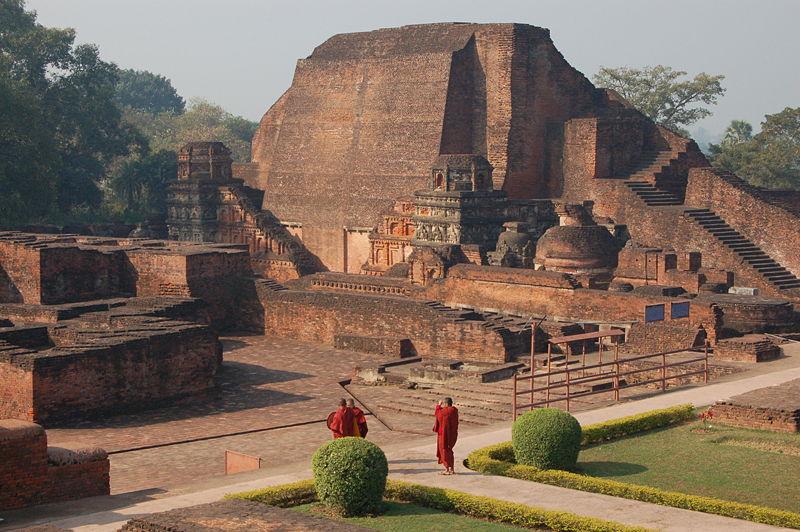
used to come to study. These are vast campuses with gaint structures and multi-storeyed libraries. In these
universities 100 lectures on various subjects were delivered every day.

Ruins of Nalanda
University (Source: https://nalandauniversity.files.wordpress.com/2011/03/nalanda_university.jpg)
One may wonder what are the subjects that are taught in these
universities. Mathematics, Economics(Arthasastra), Astronomy , Ayurveda,
Surgery, Nyaya sastra, Metallurgy and so on.
Arthasastra which
literally means science of economics was written by Kautilya, who was a scholar at Taksashila University. The book deals with
taxes to be levied on citizens , rules for spending state income on different
fields. Contrary to the assumption that the book is related to only economics,
many other subjects are dealt with. Arthasastra
consists of civil and criminal law for judiciary, marriage laws, city
planning , measures for environmental protection and war and military strategies. It also consists of organization
structure for administration and principles of rajaneeti.
Ayurveda, the
traditional system of medicine originated from India flourished from ages
till date. Susrutha considered a pioneer in this area composed Susrutha Samhitha , a treatise on
Physiolology and Surgery 2000 years ago in the form of Sanskrit verses. The book
elaborately deals with various surgical procedures (including cataract and rhinoplasty) , use of herbs for curing
diseases.Cataract surgery, surgery on nose and plastic surgeries were performed at that time. Susrutha is credited as father of surgery. Susrutha offers an
in-depth knowledge of bones , muscles , joints and different body parts.
Susrutha samhitha underwent changes in later stages, another familiar version which
is in use till now is Charaka Samhitha which
is adapted by Charaka. These texts
existed centuries before Hippocrates(A
Greek physician who is considered as father of modern medicine) lived.
India has produced numerous mathematicians from vedic period
to modern times and the contributions made by Indians to mathematics is
priceless. Apart from concept of zero, Indians made significant contributions
to number systems, decimal systems, trigonometry, geometry, arithmetic ,
algebra, calculus. Several texts on mathematics were written during different
periods viz Sulbha sutras, Satapata
brahmana, Surya siddanta, Aryabhatiyam etc. The principles of geometry were
applied to construction of sacrificial altars, buildings and gaint
architectural structures. Names were given to numbers as large as
, which were
mentioned in these texts. Mathematics used as a tool in astronomical
calculations.
Astronomy is another field which our ancestors had achieved
progress without any use of telescope. Ancient Indian astronomers believed in helio-centric
theory . They calculated the relative
motion of planets with respect to each other and derived equations for each
planets. They know the phenomenon of eclipses and precisely calculated the
occurance of solar and lunar eclipse. Thithi (rise of the moon) , sunrise and
sunset and were calculated for the whole year. Twenty Seven stars are identified
in the sky, one star appear close to the moon each day to complete 27 day cycle.
The primary purpose of Jyothishya Sastra is the preserving of this knowledge, not about horoscopes.
The language in which all the ancient texts were written is Sanskrit. All the hindu
scriptures(Ramayan and Mahabharat) , Vedas, The Bhagavadgita, Smritis were composed in Sanskrit. Sanskrit is the
common language which connects the length and breadth of this country. All the
vernacular languages originated from Sanskrit. Sanskrit is said to be the
mother of world languages. For example, the word mother comes from matru sabdh. Panchatantra, a collection
of moral stories written by Vishnu Sharma around the period 200 BCE-300BCE is in
Sanskrit. Literary works of ancient times were authored in Sanskrit and later
got translated to local languages. Kamasutra
written by vatsayana on sensuality is
also in Sanskrit.
The glory of education in the universities continued for
almost 1000-1500 years. There is discrepancy
in the date or exact time period in our history. The
texts were well recorded in the form of manuscripts on palm leaves. All the
institutes have well equipped libraries. Sanskrit manuscripts were carried
abroad.These ancients texts were translated into Chinese, Persian , Arabic etc,
thereby knowledge systems went out of India and subsequently to Europe in later
centuries. All the glory came
to an end when Turkish
invader Bakhtiyar Khilji in 1193 along with his horsemen destroyed the
universities one after the other. Teachers and students of the institutions
were killed and libraries were deliberately burnt. The picture below explains
everything. Since then the little knowledge left with the people was passed on
to generations through oral transmission. If we have to rediscover India, we
have to refer to the translated versions of ancient texts and references made
by visitors like Megasthanes and Huan Tsang.

Source: https://en.wikipedia.org/wiki/Muhammad_bin_Bakhtiyar_Khalji#/media/File:The_end_of_Buddhist_Monks,_A.D._1193.jpg
India is the richest country in the world
till 1800s. It contributed to almost 40% of the worlds GDP. India is
technologically advanced compared to rest of the world at that time. Indians had
the history of using metal from the Harrapan civilization times. Much earlier
tin is added to copper to produce bronze. Many bronze articles were found
during archaeological excavations.
Indians were the first to smelt Zinc from its ore. Adding zinc to copper
lead to the invention of brass and its wide spread usage. Archaeological
excavations at Zawar , Rajasthan shows evidence of zinc plant as early as 5th century
BCE. India was the exporter of metal works and textiles during that time.
Foreign trade existed with contemporary nations of that time. Roman empire used
to export cotton from India, gold coins were given in return. Gold and silver
were widely used for ornamental and other purposes. India could attribute it
riches to the artisan classes who produced all the commodities. The
rulers(kings ) could dedicate the required amount of taxes to support
education. It is the rest of the society that sponsored for education to
flourish , otherwise education cannot survive on its own. Varna system in India
is essentially division of labour.
Words will not suffice to describe the
architectural wonders this country has produced. If we go down
south, huge temples stand erect as symbols of our heritage even 1000 years
after they were built. Chola dynasty and pandya dynasty built the magnificent Brihadeeswara Temple at Tanjavur and Meenanaksi temple at Madhurai. Many
temples in north India were destroyed during the Islamic invasions. One could imagine
the quality and quantity of skilled sculptors to have created those many
structures. Our ancestors made chisels as pens and wrote our history on stones.
Very intricate shapes are carved on the hardest of rock. Aesthetic appeal is
induced in the very minutest detail. Sun dial is at surya devalayam , konark is an engineering and architectural marvel.
Stories from hindu scripture are carved on the pillars of the temples.
All of this is an ocean in a nutshell. The crux of the story
is the knowledge went out of India, and later into European countries and was
in popular use after the European names. Once Albert Einstein said “We owe a
lot to the Indians, who taught us how to count, without which no worthwhile
scientific discovery could have been made”. But much of the work done by
Indians left uncredited. For example , archaeological
evidence shows that Pythagorean theorem was in use in India much before pythogoras
lived. But the theorem is named after Pythagoras. Lets us hope advanced
techniques of dating archaeological manuscripts found will take India to a much
older period on civilizational chronology.
continued.....
(How decline of India continued during Islamic Invasions and The British Colonial rule will be continued in the Part II of this article)